What is FAMACHA?
A quick on-farm tool to assess anaemia in sheep and goats by checking the colour of the lower eyelid.
> Developed to detect barber’s pole worm (Haemonchus contortus), which causes blood loss.
> In the UK, Haemonchus is an increasing problem, especially in southern England and Wales, due to changing weather patterns and warmer, wetter summers.
How does it work?
The inner lower eyelid (conjunctiva) is compared against a standard FAMACHA colour chart. The colour reflects the level of anaemia, ranging from red (healthy, not anaemic) to very pale (severely anaemic).
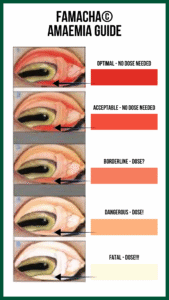
Scoring system (1–5):
1️⃣ = Red, not anaemic → no treatment
2️⃣ = Red-pink, little/no anaemia → usually no treatment
3️⃣ = Pink, mild anaemia → treat if other risk factors (young, thin, high worm challenge)
4️⃣ = Pale pink, moderate anaemia → treat
5️⃣ = White, severely anaemic → treat immediately (animal may need supportive care)
UK Use & Limitations
In the UK, most worm burdens are mixed (not just Haemonchus). We advise that you do not use FAMACHA as a standalone tool – it works best in combination with:
> Faecal Egg Counts (FECs)
> Body Condition Scoring (BCS)
> Monitoring scouring & growth rates
> Pasture risk assessment
It is not useful for worms that don’t cause anaemia (e.g. Teladorsagia and Trichostrongylus).
Veterinary guidance is recommended initially to ensure scoring is done correctly and consistently. We can now do Haemonchus speciation on faecal samples with our on-site Ovacyte FEC machine. This will allow us to more accurately advise you on the presence, and more importantly, the best course of treatment for your flock.
✅ Key Benefits
The FAMACHA tool reduces unnecessary worming (supports Targeted Selective Treatment – TST), helps delay anthelmintic resistance, and allows farmers to focus treatment on individuals that need it most.
Contact us and speak to one of the farm vets for more information and guidance.
RIU Pocket Guide


